 By Graham Fisher
Updated November 2026
Choosing a fiskars staysharp reel mower, or a comparable push reel model, comes down to three things: cutting width relative to your lawn size, blade count and how much maintenance you want to do. This list weighs each option by the lawn size it suits, the cutting width and blade count the manufacturer specifies, and the patterns owners commonly report about sharpness and ease of use. Nothing here comes from our own testing.
Our top picks at a glance
- 1
 TOP CHOICEBest overallFiskars StaySharp MaxView on Amazon
- 2
 TOP CHOICEBest for a small, tight yardLawnMaster LMRM1801 Push Reel Lawn Mower 18-Inch 5-BladeView on Amazon
- 3
 TOP CHOICEBest for a mid-sized lawnLawnMaster 20" 5-Blade Push Reel Lawn Mower – LMRM2001View on Amazon
- 4
 Best for traditional steel-blade valueGreat States 815-18 18-Inch 5-Blade Push Reel Lawn Mower, GreyView on Amazon
- 5
 Best for a narrow strip or small patchAmerican Lawn Mower 1204-14 14-Inch 4-Blade Push Reel Lawn Mower, RedView on Amazon
- 6
 Best for a larger open lawnScotts 2000-20S 20-Inch 5-Blade Push Reel Lawn Mower, GreenView on Amazon
- 7
 Best for a finer, denser cutScotts 716-18S 18-Inch 7-Blade Push Reel Lawn Mower, GreenView on Amazon
Our Top Picks
| Product | Best for | Key feature |
|---|---|---|
| Fiskars StaySharp Max | Overall balance of cut and upkeep | Non-contact cutting system |
| LawnMaster LMRM1801 18-Inch | Small, tight yards | 5-blade, 18-inch width |
| LawnMaster 20-Inch LMRM2001 | Mid-sized lawns | 5-blade, 20-inch width |
| Great States 815-18 18-Inch | Traditional steel-blade value | 5-blade, 18-inch width |
| American Lawn Mower 1204-14 | Narrow strips and small patches | 4-blade, 14-inch width |
| Scotts 2000-20S 20-Inch | Larger open lawns | 5-blade, 20-inch width |
| Scotts 716-18S 18-Inch | Finer, denser cut | 7-blade, 18-inch width |
Fiskars StaySharp Max
FiskarsCutting width: 46 cm, StaySharp Max, Black/Orange/Silver, 1000591 Spindle mower, lawn mower with non-contact cutting system
Best for: Overall balance of cut and upkeep
Suited to homeowners with a modest lawn who want a reel mower that holds an edge with minimal adjustment. The 46 cm cutting width is the manufacturer’s specification.
Pros
- Non-contact cutting system reduces blade wear
- Compact width is easy to push
Cons
- Narrower width means more passes on larger lawns
LawnMaster LMRM1801 Push Reel Lawn Mower 18-Inch 5-Blade
LawnMaster LMRM1801 Push Reel Lawn Mower 18-Inch 5-Blade
Best for: Small, tight yards
A good match for small lawns with tight corners where a wider mower would be awkward to turn. Owners often report it handles compact spaces well.
Pros
- Five blades give a fine, even cut
- Light enough for smaller users
Cons
- Requires more passes on medium lawns
LawnMaster 20″ 5-Blade Push Reel Lawn Mower – LMRM2001
LawnMaster 20” 5-Blade Push Reel Lawn Mower – LMRM2001
Best for: Mid-sized lawns
Fits homeowners whose lawn is too large for an 18-inch model but who still want a manual, quiet machine. The 20-inch width is the manufacturer’s specification.
Pros
- Wider deck covers ground faster than 18-inch models
- Five blades keep the cut consistent
Cons
- Heavier to push on uneven ground
Great States 815-18 18-Inch 5-Blade Push Reel Lawn Mower, Grey
Great States 815-18 18-Inch 5-Blade Push Reel Lawn Mower, Grey
Best for: Traditional steel-blade value
Aimed at buyers who prefer a classic reel design and are comfortable with periodic blade adjustment and sharpening.
Pros
- Classic steel construction is widely serviceable
- Five blades for a clean finish
Cons
- Needs regular adjustment to stay sharp
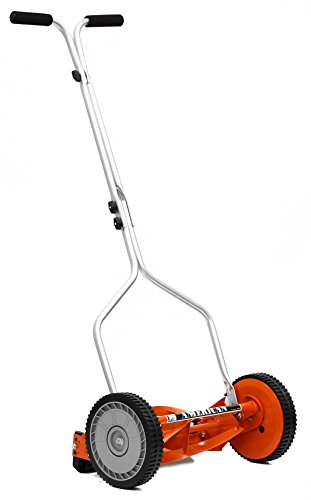
American Lawn Mower 1204-14 14-Inch 4-Blade Push Reel Lawn Mower, Red
American Lawn Mower 1204-14 14-Inch 4-Blade Push Reel Lawn Mower, Red
Best for: Narrow strips and small patches
Suited to very small areas, such as strips beside a walkway or a patch of turf around a garden bed. The 14-inch width is the manufacturer’s specification.
Pros
- Very light and easy to maneuver
- Simple design with few parts
Cons
- Too narrow for anything beyond small areas
Scotts 2000-20S 20-Inch 5-Blade Push Reel Lawn Mower, Green
Scotts 2000-20S 20-Inch 5-Blade Push Reel Lawn Mower, Green
Best for: Larger open lawns
A practical choice for bigger lawns where the wide 20-inch deck saves time. Owners often report it works best on relatively level turf.
Pros
- Wide cut reduces the number of passes
- Five blades for an even result
Cons
- Heavier to push on hills
Buying Guide
Lawn Size and Cutting Width
Cutting width is the single biggest factor in how long mowing takes. Narrower models, such as the 14-inch options, suit small yards and tight spaces, while 18- and 20-inch models cover larger areas with fewer passes. Match the width to the size and shape of your lawn, keeping in mind that wider mowers can be harder to steer around flower beds and obstacles.
Blade Count and Cut Quality
More blades generally mean a finer, more even cut, since each blade makes smaller passes over the grass. Four-blade and five-blade models are typical for regular home lawns, while seven-blade designs tend to produce a closer finish. Keep in mind that more blades can mean slightly more effort to push, so consider how dense and tall your grass usually is.
Blade Sharpness and Maintenance
Reel mowers depend on sharp blades that cut cleanly rather than tearing grass. Look at how each model’s blades are designed to hold an edge and how easily they can be adjusted or sharpened at home. Staying on top of maintenance, including regular cleaning and blade adjustment, will keep performance consistent over the life of the mower. Worth reading next: 5 Best Lawn Mower Blade Sharpening Machine Options for Home Use (2026).
Ease of Use and Weight
Because a push reel mower relies entirely on your own power, weight and handle comfort matter a lot. Lighter frames are easier to maneuver and store, but heavier models can feel more stable on uneven ground. Check the handle height and adjustability if you have a taller or shorter build, since this affects comfort over a full mowing session.
FAQ
Is a reel mower good for large lawns?
Reel mowers work best on small to medium lawns with relatively flat, even ground. Very large or uneven yards can take a long time to mow by hand, so a wider cutting width helps. For big properties, you may find a powered mower more practical.
How often should I sharpen the blades?
The right schedule depends on how often you mow and what you mow over, such as sand or debris that dulls blades faster. Many owners check blade sharpness at the start of each season and adjust as needed. Dull blades tend to leave ragged, brownish tips, which is a sign it is time for attention.
Can a reel mower cut tall or thick grass?
Reel mowers are generally designed for regular trimming rather than cutting very tall or overgrown grass. Mowing more often and removing no more than a third of the grass height at a time gives the best results. Taller growth may need to be cut in stages.
Do reel mowers need to be stored differently than gas mowers?
Reel mowers have no engine, so they do not need fuel or oil, which simplifies winter storage. Keep the blades clean and dry to prevent rust, and store the mower in a sheltered place. A light coat of oil on the blades can help protect them while stored.
Which mower is best for a small yard?
A narrower model, such as a 14-inch or 18-inch option, is usually the easiest choice for a small yard. The smaller footprint makes it simpler to turn and store. Choose the blade count based on how fine a cut you want.
Are reel mowers safe for kids or pets to be around?
Reel mowers do not have an engine or exhaust, which makes them quieter and easier to use around people and animals. The blades are still sharp and moving, so keep children and pets clear of the mower while it is in use. Store it safely when not in use.
Conclusion
If you have a small to medium lawn and want a quiet, low-maintenance option with a fine cut, the Fiskars StaySharp Max and the 18-inch five-blade models are strong starting points. Owners with smaller yards or tight spaces may prefer the 14-inch American Lawn Mower option, while those with larger flat lawns may benefit from the wider 20-inch models.
For a closer finish and willingness to do a bit more upkeep, the seven-blade Scotts model suits gardeners who value a neat appearance. Weigh cutting width, blade count and maintenance needs against your own yard, and the right choice should become clear.
Related reading
- Fiskars StaySharp Max Reel Mower: 6 Best Reel Mowers Compared (2026)
- Reel Lawn Mower Fiskars: Buyer's Guide for Small to Mid-Size Lawns
- What Reel Mower Cutting Widths Are Available? A Size Guide
About Graham Fisher
Graham Fisher is part of our editorial team and reviews and edits our lawn mowers guides, checking product details against manufacturer specifications and owner feedback.